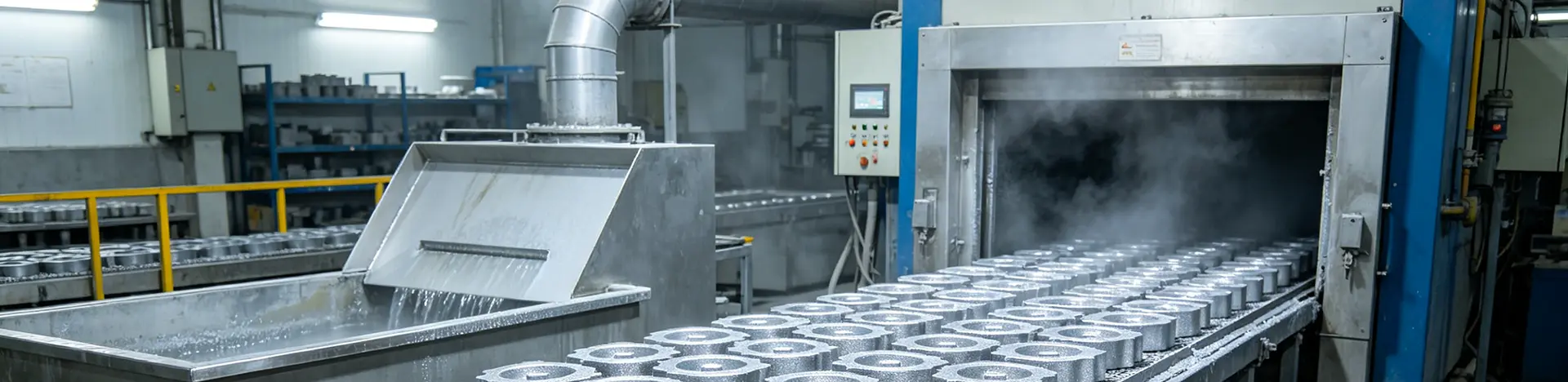
Dacromet Surface Treatment
From automotive chassis fasteners to industrial structural components, our Dacromet coating solutions are widely used in applications requiring long-term rust and corrosion prevention. This technology offers hydrogen embrittlement-free, high-temperature resistance, thin and uniform coating, and excellent salt spray resistance, making it an ideal alternative to traditional zinc electroplating and hot-dip galvanizing.
Dacromet Surface Treatment Process Overview
Surface Preparation
Coating Preparation
Coating Application
Curing & Sintering
Cooling & Final Inspection
Surface Preparation
Parts must be thoroughly cleaned before Dacromet coating application. Degreasing, shot blasting or sandblasting processes remove oil, rust, scale and existing coatings, obtaining a clean, uniform metal substrate surface with appropriate roughness. Proper pretreatment is the critical prerequisite for ensuring coating adhesion and corrosion resistance.
Coating Preparation
Dacromet coating solution is prepared by mixing flake zinc powder, aluminum powder, special binders and deionized water in precise proportions. The solution must be thoroughly stirred and aged to ensure uniform dispersion of all components, achieving appropriate viscosity and rheological properties. The prepared coating solution must be used within its effective period to ensure coating performance consistency.
Coating Application
Dacromet coating solution is uniformly applied to part surfaces using dip coating, spray coating or dip-spin processes. Dip coating suits small-sized parts in batch quantities, while spray coating suits large or complex-shaped parts. Coating temperature, viscosity and application time are strictly controlled to ensure uniform and controllable coating thickness without runs, misses or other defects.
Curing & Sintering
Coated parts enter a high-temperature furnace for curing and sintering. At approximately 300°C, water in the coating evaporates, binders undergo thermal cross-linking reactions, and zinc/aluminum flakes fuse together to form a dense inorganic protective layer. The sintering process creates chemical bonding between the coating and metal substrate, significantly enhancing adhesion and corrosion resistance. Strict control of furnace temperature profile and holding time is essential for obtaining high-quality coatings.
Cooling & Final Inspection
Sintered parts are cooled to room temperature through natural or forced air cooling. Collisions are avoided during cooling to prevent coating damage. Final inspection includes coating appearance check (uniform, continuous, defect-free), thickness measurement, adhesion testing and salt spray testing, ensuring Dacromet coating meets customer requirements for corrosion resistance and appearance. Qualified parts are packaged and delivered.
Advantages of Dacromet Surface Treatment
Superior Corrosion Resistance
Achieves hundreds to thousands of hours in salt spray tests without red rust.
Hydrogen Embrittlement-Free
No hydrogen ions generated during the process, suitable for high-strength parts.
High Temperature Resistance
Coating withstands temperatures up to 300°C while maintaining protective properties.
Uniform Coating Thickness
Provides uniform coverage without dead zones, even on complex-shaped parts.
Comparison with Other Manufacturing Processes
Dacromet vs. Electroplating
Dacromet coating has no hydrogen embrittlement risk, making it especially suitable for high-strength steel parts (such as grade 10.9 and above fasteners). Electroplating may introduce hydrogen ions into parts during the process, leading to hydrogen embrittlement fracture. Additionally, Dacromet offers far superior salt spray resistance compared to zinc electroplating, achieving hundreds to thousands of hours.
Dacromet vs. Hot-Dip Galvanizing
Dacromet coating provides uniform thickness (typically 8-15μm) without dead zones, suitable for precision-fit parts. Hot-dip galvanizing produces thicker coatings (typically 40-100μm+), which may affect thread fit and dimensional accuracy, and its high processing temperature (approx. 450°C) can cause distortion of thin-walled parts.
Dacromet vs. Painting
Dacromet is an inorganic coating with excellent high-temperature resistance (withstanding up to 300°C), high hardness and good wear resistance. Organic coatings (such as paint) are prone to aging and peeling at high temperatures, but offer richer color options and better decorative appearance.
Dacromet vs. Zinc Flake Coating (Chromium-Free)
Both share similar principles and belong to the zinc-aluminum flake coating system. Traditional Dacromet contains trace amounts of hexavalent chromium, while environmentally friendly chromium-free zinc-aluminum coatings (such as Geomet) contain no chromium at all. Both offer comparable corrosion resistance, but the chromium-free version better meets current environmental regulations and is gradually becoming the mainstream.
Start Your PM Quote
All information and file uploads are secure and strictly confidential.