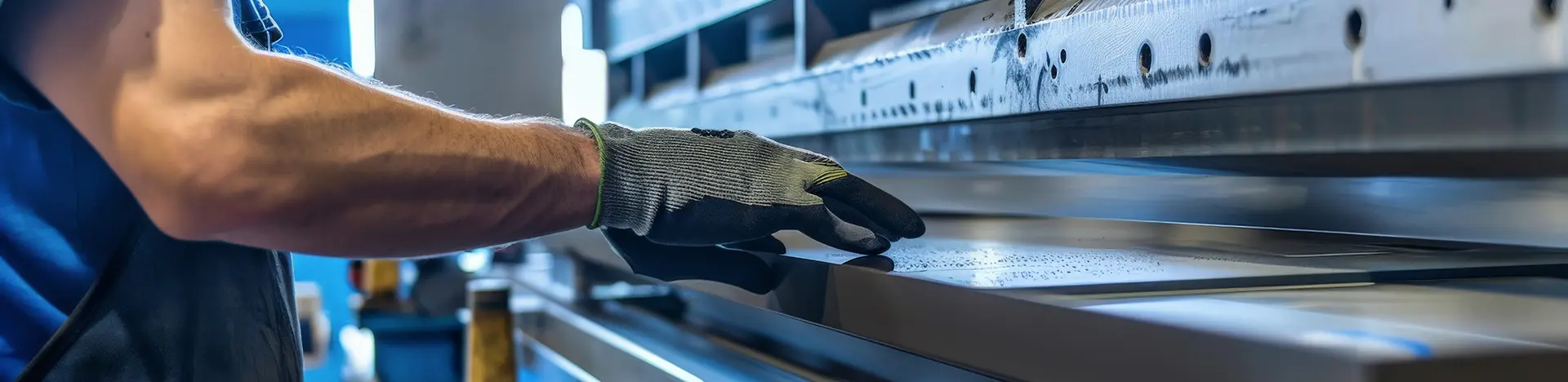
Steel Sheet Stamping
From automotive components to industrial equipment structural parts, our stamping solutions cover multiple application fields. With advanced stamping equipment, precision die design capabilities and strict process control, we produce complex-shaped, dimensionally consistent stamped parts that meet customer requirements for both precision and reliability.
Steel Sheet Stamping Process Overview
Material Preparation
Blank Feeding & Positioning
Stamping & Forming
Deburring & Edge Trimming
Inspection & Quality Control
Material Preparation
High-quality cold-rolled or hot-rolled steel sheets and strips are selected as raw materials. Based on product drawing requirements, steel with appropriate grade, thickness and surface condition is chosen. Incoming raw materials undergo rigorous chemical composition and mechanical property testing to ensure compliance with relevant industry standards and customer specifications.
Blank Feeding & Positioning
Steel strips are precisely fed into the stamping die working area via automatic feeding equipment. High-precision sensors and servo control systems ensure consistent feed pitch and accurate positioning. For complex parts, multi-station progressive die designs are employed to achieve continuous, high-efficiency production cycles.
Stamping & Forming
Specialized dies are installed on stamping presses, applying pressure to metal sheets through the interaction of punch and die to induce plastic deformation or separation. Depending on part requirements, single or compound processes such as blanking, piercing, bending, drawing and flanging are applied to obtain semi-finished or finished parts with required shapes and dimensions. Stamping offers high production efficiency, excellent dimensional accuracy and good consistency.
Deburring & Edge Trimming
After stamping, part edges may have burrs or irregularities. Burrs are removed through vibratory finishing, barrel polishing or dedicated trimming dies, resulting in smooth and safe edges to ensure reliable subsequent assembly and usage. For precision parts, precision trimming processes control burr height within customer-specified ranges.
Inspection & Quality Control
Key dimensions of stamped parts are inspected through sampling or 100% inspection using calipers, profile projectors, CMM and other measuring equipment. Statistical process control methods monitor production stability, ensuring each batch meets drawing requirements and quality standards. Qualified parts proceed to the next process or are packaged and stored.
Advantages of Steel Sheet Stamping
High Productivity
Suitable for high-volume production with fast cycle times and high output.
Excellent Consistency
Dies ensure high dimensional consistency and interchangeability of products.
Material Savings
Optimized nesting significantly improves material utilization and reduces scrap.
Versatile Material Compatibility
Compatible with various steel grades including mild steel, stainless steel and high-strength steel.
Comparison with Other Manufacturing Processes
Stamping vs. Casting
Stamping offers significant cost and productivity advantages in high-volume production, with high material utilization and better surface quality and dimensional consistency. Casting is more suitable for parts with complex internal cavities or extremely thick cross-sections.
Stamping vs. Powder Metallurgy
Stamping is suitable for thin-walled, flat and shallow-drawn parts made from dense steel sheets with excellent ductility and toughness. Powder metallurgy is better suited for small to medium-sized parts with complex 3D shapes, self-lubricating properties or special material compositions.
Stamping vs. Forging
Stamping processes sheet metal to produce thin-walled parts with extremely high productivity. Forging processes thick-section blanks to produce high-strength solid parts such as gears and crankshafts, but with relatively lower productivity and higher cost.
Stamping vs. Additive Manufacturing
Stamping is one of the most cost-effective methods for high-volume production of 2D and shallow 3D shaped parts. Additive manufacturing suits low-volume, highly customized parts or those with special features like internal complex channels, but with slow production speed and high per-part cost.
Start Your PM Quote
All information and file uploads are secure and strictly confidential.